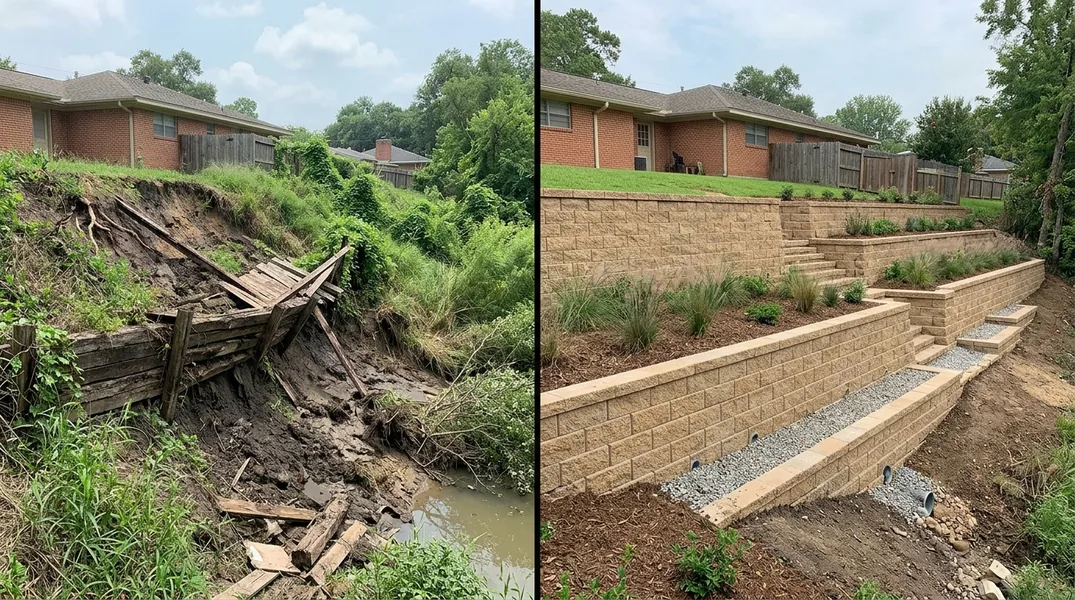
Why Drainage Failures Are the Silent Killer of Retaining Walls
When Houston homeowners think about retaining wall damage, they often picture catastrophic structural failure or impact from severe weather. The truth is far more insidious. Most retaining wall failures happen quietly, over months or even years, as water accumulates behind the wall and exerts relentless pressure on the structure. This phenomenon, called hydrostatic pressure on retaining walls, is the leading cause of wall deterioration in our region, and it's almost entirely preventable with proper retaining wall drainage design and maintenance.
During Houston's hurricane season, the problem accelerates dramatically. Heavy rainfall, often measured in inches per hour, overwhelms poorly designed drainage systems. Soil becomes saturated, water has nowhere to escape, and the pressure builds exponentially. What might have been a manageable moisture problem in dry months becomes a critical structural emergency when tropical storms roll through. Understanding how drainage failures occur is the first step toward protecting your property and avoiding costly Retaining Wall Repair or replacement down the road.
Understanding Hydrostatic Pressure and Its Destructive Force
Hydrostatic pressure is simply the force exerted by water pushing against a surface. When soil becomes saturated behind a retaining wall, every cubic foot of that wet soil presses harder on the wall structure than dry soil would. This pressure increases with depth, meaning the bottom of your wall experiences far greater stress than the top. Unlike wind or seismic forces, which are intermittent, hydrostatic pressure is constant and relentless whenever moisture is present in the soil.
The math is sobering. Saturated soil can exert pressures of 60 to 100 pounds per square foot, depending on soil type and depth. For a wall that's 10 feet tall, that translates to hundreds of tons of force pushing outward. Without adequate drainage, this pressure causes the wall to bow outward, crack, settle unevenly, or fail entirely. Concrete retaining walls are particularly vulnerable because concrete, while strong in compression, can develop structural cracks under sustained lateral pressure. Once cracks form, water infiltrates deeper into the structure, accelerating deterioration through freeze-thaw cycles and reinforcement corrosion.
How Retaining Wall French Drains Prevent Catastrophic Failure
A properly installed retaining wall french drain is the most effective defense against hydrostatic pressure. French drains work by intercepting groundwater before it accumulates against the wall and channeling it safely away. The system typically consists of a perforated pipe wrapped in geotextile fabric, surrounded by gravel, installed at the base of the wall and along its height. Water enters the perforations, flows through the pipe, and exits at a downslope location where it can drain naturally or into a storm system.
The key to french drain effectiveness is proper installation and material selection. The pipe must be truly perforated on all sides, not just the bottom, and it must be sized correctly for the volume of water your property receives. The gravel surrounding the pipe should be clean and properly graded to facilitate water movement without clogging. Many homeowners discover too late that their retaining wall never had a french drain installed, or that a poorly designed system was installed years ago and is now clogged with silt and sediment. If you're concerned about your wall's drainage, a professional inspection can reveal whether your current system is functioning or failing.
Why Hurricane Season Exposes Drainage Weaknesses in Houston
Houston's geography and climate make retaining wall drainage particularly critical. Our region receives substantial rainfall throughout the year, but hurricane season from June through November brings intense precipitation events that can dump 10 to 20 inches of rain in just 24 to 48 hours. When a drainage system is inadequate or failing, these storms create a perfect storm of conditions for wall failure. Soil that's already somewhat saturated from normal rainfall becomes completely waterlogged, and the system has no capacity to handle the excess water.
Additionally, Houston's clay-heavy soils compound the problem. Clay has low permeability, meaning water moves through it very slowly. This creates a natural tendency for water to pool behind retaining walls rather than drain away naturally. During hurricane season, when rainfall rates exceed the soil's ability to absorb or drain water, hydrostatic pressure builds rapidly. Homeowners who haven't invested in proper retaining wall drainage systems often face emergencies during or immediately after major storms, when contractors are overwhelmed and emergency repairs are exponentially more expensive than preventive maintenance.
Retaining Wall Installation Near Me: When to Call a Professional
If you have an existing retaining wall or are planning new Retaining Wall Installation, drainage should be a non-negotiable part of the design. Many DIY installations or budget-conscious contractor jobs skip proper drainage to save money upfront, only to cost the homeowner thousands in repairs later. A professional installation includes site assessment to understand water flow patterns, proper french drain design tailored to your soil and slope conditions, and installation techniques that ensure the system functions for decades.
The best time to address drainage is before problems develop. If you notice water pooling near your retaining wall, seepage through the wall face, or visible cracks and bowing, these are signs that hydrostatic pressure is already damaging your structure. Don't wait for a hurricane to force the issue. Contact Houston Retaining Wall today at (346) 258-3418 to schedule a free estimate and professional assessment. Our team can evaluate your current wall's drainage performance and recommend whether repairs, french drain installation, or complete Retaining Wall Replacement is the best solution for your property.
Maintenance and Monitoring: Keeping Your Drainage System Effective
Installing a french drain is not a set-it-and-forget-it solution. Over time, gravel can shift, pipes can become clogged with sediment and organic matter, and soil can settle around the drainage system, compromising its effectiveness. Regular inspection and maintenance are essential to ensure your retaining wall drainage system continues to perform. Before hurricane season each year, have a professional inspect your wall and drainage system to identify any potential issues. Clean gutters and downspouts on nearby structures to prevent concentrated water flow toward your wall. Ensure that surface water is graded away from the wall and that landscape features don't trap moisture against the structure.
If you notice changes in your wall's condition, such as new cracks, increased seepage, or visible bulging, these are warning signs that your drainage system may be failing. Address these issues promptly before they escalate into major structural problems. The cost of preventive maintenance and minor repairs is a fraction of what you'll spend on emergency stabilization or complete wall replacement. Houston Retaining Wall has helped hundreds of homeowners throughout the region protect their properties with proper drainage solutions. If you're concerned about your retaining wall's performance or want to ensure your drainage system is hurricane-ready, reach out to us at (346) 258-3418 or visit our website at https://houston-retaining-wall.com for more information.
Looking for a professional retaining wall contractor in Houston? Houston Retaining Wall responds fast for all your retaining wall needs.
Get a Free QuoteOur services: Retaining Wall Installation · Retaining Wall Repair · Retaining Wall Replacement