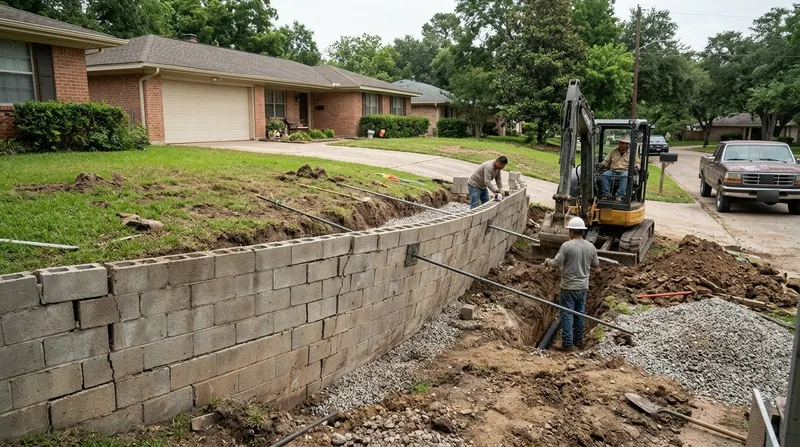




Leaning & Collapsed Wall Repair in Houston demands fast action. Houston's expansive black gumbo clay swells and shrinks with seasonal moisture, the water table sits high after tropical storms, and ground subsidence is common across the Gulf Coastal Plain. Retaining walls that support driveways, pools, and raised beds fail catastrophically when hydrostatic pressure builds behind them or when the clay foundation shifts. Whether your wall is tilting 2 inches or has cracked open entirely, we stabilize it with tieback anchors, correct the drainage that caused the failure, and rebuild when necessary. Call (346) 258-3418 for same-day emergency response in Houston, Sugar Land, Pearland, and the surrounding area, or request a free estimate to get a contractor on your property within 24 hours.
Why Leaning and Collapsed Walls Fail So Fast in Houston
Houston sits on soft, clay-rich soil that does not stay stable when water pressure builds. After heavy rain, tropical storms, or hurricane-season downpours, water saturates the clay behind a retaining wall. The soil expands, pushing outward with tremendous force. At the same time, ground subsidence from aquifer depletion and the region's age-old drainage patterns means the footing can settle unevenly, cracking the wall from the inside out. Older poured-concrete walls and CMU bayou-bank walls, common in neighborhoods like the Heights, River Oaks, and Meyerland, are especially vulnerable because they were often built without proper drainage or engineered tieback systems.
- Expansive clay swelling puts outward pressure on the wall face, causing bulging and horizontal cracks.
- Poor or blocked drainage behind the wall traps water and multiplies hydrostatic load year-round.
- Ground subsidence and settling shift the footing, opening vertical cracks and tilting the entire structure.
- Saturated clay loses bearing capacity, and the wall simply slides or tips forward without warning.
- Tiered walls and walls supporting surcharges (driveways, structures) fail faster because the load is concentrated.
These failures happen in all seasons, but heavy rain and tropical storm season from June through November accelerate collapse.
Key info: In Houston neighborhoods like Kingwood, Clear Lake, and the master-planned suburbs, 1970s-80s brick homes often have segmental block walls around pools and raised beds. These walls fail when the drainage blanket behind them clogs with clay fines or when the base settles into subsiding soil. We see this pattern repeatedly in the Bellaire and Atascocita areas after wet summers.
For permit and regulatory guidance specific to your location, refer to your local Houston-area city or county building department, which sets setback rules and wall height thresholds that vary by jurisdiction.
How We Stabilize and Repair Leaning Walls in Houston
Our process begins with a site inspection to assess the wall's tilt, cracks, and drainage condition. We measure the angle of lean, probe the soil, and check for water seeping behind or below the wall. Once we understand the failure mode, we choose the right repair method: tieback anchors to hold the wall in place while we rebuild, improved drainage to stop hydrostatic pressure, or a partial or full replacement if the wall is too far gone. Each job is customized to Houston's clay and water table.
- We excavate and expose the wall base and the soil profile behind it to assess settlement and drainage failure.
- We install or repair the drainage system: perforated pipe, gravel, and filter fabric to shed water away from the wall.
- We install tieback anchors or deadman anchors into stable soil to hold the wall face in place during repair.
- We rebuild the wall section by section, resetting the base on solid footing and restoring proper backfill.
- We compact and grade the site to ensure surface water runs away from the wall, not toward it.
The entire process keeps your property safe and prevents further settlement or collapse.
Real example: A homeowner in Missouri City had a 12-foot poured-concrete wall tilting 3 inches at the top. The drainage pipe behind it was crushed and clogged. We installed tieback anchors to stabilize the lean, replaced the drainage system with new perforated pipe and filter fabric, and reset the base. The wall now stands plumb and dry. Total time on site: 5 working days.
For more on how drainage problems trigger wall failure, see our guide to retaining wall drainage in Houston.
Leaning & Collapsed Wall Repair Methods and When to Use Them
| Approach | Description | Best for |
|---|---|---|
| Tieback Anchors | Steel anchors or rods driven into stable soil behind and below the wall, then tensioned to hold the face in place. | Walls leaning less than 4 inches, where the base is still sound and the clay below is dense enough to anchor into. |
| Drainage Repair and Replacement | Excavate behind the wall, remove clogged or crushed pipe, install new perforated drain pipe with gravel and filter fabric, and restore proper slope away from the wall. | Any wall with water seeping, bulging, or visible cracks, especially after rain. Often done in tandem with anchors. |
| Partial Wall Rebuild | Remove the damaged section (typically the top half or a corner), reset the base on solid footing, and rebuild with proper drainage and tieback support. | Walls with severe cracking, bowing, or settlement in one section. Preserves the lower, stable portion of the existing wall. |
| Full Wall Replacement | Remove the entire wall, excavate the footing to stable soil, install new drainage, and rebuild the wall with engineered design and tieback anchors if needed. | Walls that are cracked throughout, leaning more than 6 inches, or where the footing has settled so far that anchoring is not safe. |
Leaning & Collapsed Wall Repair Cost in Houston: What to Expect
Leaning & Collapsed Wall Repair cost in Houston ranges from $2,500 for a small drainage fix and tieback anchor system on a 20-foot wall to $15,000 or more for a full replacement of a 30-foot section with new engineered design. The price depends on the wall's height, length, the extent of the lean or collapse, soil conditions, and whether you need a full rebuild or just anchoring and drainage repair. Access matters too: a wall in a tight corner lot or behind a home costs more to mobilize than one on open ground.
We always recommend getting 2 to 3 estimates from licensed contractors. Each should include an on-site inspection, a clear breakdown of labor and materials, and a timeline. Ask each contractor whether they handle permitting or if you need to pull permits yourself (many Houston jurisdictions require permits for walls over 4 feet or walls supporting a surcharge). Once you have estimates in hand, choose the contractor who explains the repair method clearly and provides references from recent similar work.
For a detailed pricing overview and to see typical costs for different wall types and repair scopes, visit our pricing page. Call (346) 258-3418 for a free, no-obligation estimate at your property.
What to Look for When Hiring a Retaining Wall Contractor Near Me in Houston
Choosing the right contractor for leaning and collapsed wall repair near Houston means checking credentials, experience, and communication. Start by verifying that the contractor is licensed and insured in your city or county. Ask for proof of general liability and workers' compensation insurance, and request a certificate of insurance before work begins.
Second, ask for references from homeowners with similar wall repairs completed in the last two years. A contractor who has repaired leaning walls in Pearland, League City, or Tomball should be able to show you photos and give you contact information for past clients. Third, understand your local permit requirements. Many Houston-area cities require a permit for walls above 4 feet or walls that support a driveway or structure. Your contractor should know this and guide you through the process, or at least tell you clearly what you need to do. Finally, if you have an HOA, check whether the repair requires architectural approval before you start. Some master-planned communities in The Woodlands, Sugar Land, and Conroe have strict design rules.
Contact us for a free estimate and to discuss your wall's specific condition with a contractor who knows Houston's clay and weather.
Leaning & Collapsed Wall Repair in Houston: Pricing Guide
| Service | Price | Details |
|---|---|---|
| Tieback Anchors and Drainage Repair | Starting at $2,500 | Stabilization with anchors, drainage system replacement, and site grading. Cost depends on wall length and depth of excavation required. |
| Partial Wall Rebuild | Starting at $6,500 | Removal and rebuild of one section, new footing, drainage, and tieback support. Price increases with wall height and extent of damage. |
| Full Wall Replacement | Starting at $12,000 | Complete removal, new footing excavation, drainage system, and full rebuild with engineered design. Reflects wall length, height, and material choice. |
| Emergency Stabilization | Starting at $1,500 | Temporary bracing or anchoring to prevent further collapse while you plan the full repair. Available 24 hours, 7 days a week. |
| Free Estimate and Inspection | Free | On-site assessment, photos, and repair recommendation within 24 hours. Call (346) 258-3418 to schedule. |
Indicative pricing, the exact cost depends on square footage, finish, and site access. Free personalized estimate within 24h at (346) 258-3418.


