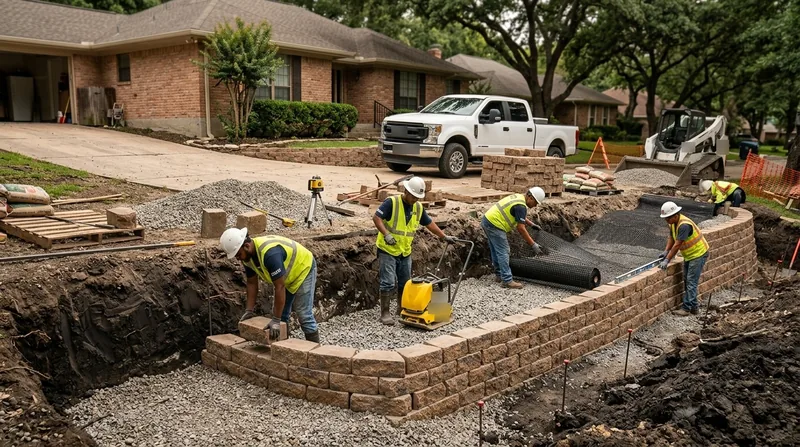




Block and segmental retaining walls in Houston are engineered mortarless systems built from interlocking concrete units, ideal for the specific challenges of the Gulf Coastal Plain. Houston's flat terrain, expansive black gumbo clay, high water table, and intense rainfall create conditions where traditional timber and poured-concrete walls fail within 10 to 15 years. Segmental retaining walls (SRW) from manufacturers like Allan Block, Versa-Lok, and Keystone handle these stresses through geogrid reinforcement, internal drainage, and flexibility that moves with soil settlement and clay expansion. Whether you need a raised planting bed in Bellaire, pool surrounds in The Woodlands, or slope stabilization along a bayou-bank property in the Heights, block walls deliver durability and clean aesthetics. This guide covers why these walls matter in Houston, how we build them, costs you can expect, and what to look for when hiring a contractor near you.
Why Block and Segmental Retaining Walls Matter in Houston's Climate and Terrain
Houston sits on the Gulf Coastal Plain, where soil conditions and weather patterns demand retaining walls that flex and drain. The region's black gumbo clay swells in wet months and shrinks in dry spells, exerting lateral pressure that cracks rigid walls. Add a high water table, torrential hurricane and tropical storm rain, and ground subsidence from decades of groundwater extraction, and you have a landscape where engineered segmental block outperforms monolithic concrete and timber by years. Homeowners across Sugar Land, Pearland, Katy, and the inner Heights have learned that block walls with proper geogrid and drainage survive where other systems buckle.
- Mortarless block design allows controlled movement and settlement without cracking.
- Geogrid reinforcement distributes lateral soil pressure across the wall structure.
- Internal and external drainage prevents hydrostatic buildup that causes failure in clay-heavy soils.
- Curves, tiered designs, and varied heights are simple to achieve with block systems.
- Raised beds, pool surrounds, and garden walls integrate seamlessly into residential landscaping.
Block walls are the standard choice for Houston homeowners who want a wall that lasts 25 to 40 years without the constant repair costs of timber or the crack risk of poured concrete.
Key info: Many Houston jurisdictions require a permit for walls above roughly 4 feet measured from the footing. Verify setback and property-line rules with your local building department before starting. The Harris County Engineering Department and City of Houston Building Services both maintain specific thresholds and engineered-drawing requirements for tall or tiered walls. Always check locally, as rules vary by municipality across the service area.
For more on how drainage prevents wall failure in Houston's wet climate, see our retaining wall drainage guide.
How We Install Block and Segmental Retaining Walls in Houston
Building a segmental block wall in Houston requires careful site prep, proper drainage design, and precise unit layout to handle soil movement and seasonal water shifts. We start with a site visit to assess soil type, water table depth, and load conditions, then design the wall with geogrid spacing and height that meet local code. The process is straightforward but demands attention to footing depth, compaction, and drainage fabric to ensure the wall performs for decades in Houston's clay-heavy environment.
- Excavate and prepare a level footing trench below the frost line (typically 12 to 18 inches in Houston).
- Compact the base with crushed stone and lay geotextile fabric to separate soil from gravel drainage layer.
- Set the first course of block level and square, using a laser level to ensure proper alignment.
- Backfill behind the first course with compacted drainage stone and lay the first geogrid layer.
- Stack subsequent courses, setting geogrid every 12 to 24 inches depending on wall height and soil conditions.
- Install perforated drain pipe at the base and wrap the entire back face with drainage fabric to shed water.
- Compact backfill in lifts to prevent settlement and ensure the wall settles evenly with the soil.
- Cap the top course with finished coping units for a clean, durable edge.
Each step is tailored to Houston's specific soil and water conditions, ensuring the wall moves slightly as clay expands and contracts without cracking or leaning.
Local example: A 4-foot raised planting bed in Missouri City with black gumbo clay and a high water table requires a 12-inch footing, two layers of geogrid, and a full drainage system. In Baytown, where subsidence is more pronounced, we often recommend deeper footings and heavier geogrid reinforcement. In all cases, proper drainage is non-negotiable; water trapped behind a block wall will eventually fail it.
See our retaining wall installation page for more detail on site preparation and design.
Block and Segmental Retaining Wall Methods and Material Options
| Approach | Description | Best for |
|---|---|---|
| Allan Block SRW | Lightweight, textured concrete units with a sloped back face and integral setback; units interlock without mortar. | Residential raised beds, pool surrounds, and landscape features up to 8 feet in Houston's clay soils. |
| Versa-Lok Blocks | Solid or hollow modular units with straight or segmented faces; excellent for curves and complex geometry. | Curved garden walls, tiered designs, and applications where aesthetics and flexibility are priorities. |
| Keystone Blocks | Heavy-duty units with tapered faces and strong mechanical interlock; available in multiple finishes and colors. | Taller walls (6 to 10 feet), commercial properties, and sites with high lateral load or slope conditions. |
| Geogrid Reinforcement | High-strength polymer or fiberglass grid laid horizontally between block courses to distribute lateral pressure. | All segmental walls in Houston; essential for clay soils, high water tables, and walls over 4 feet. |
| Drainage and Fabric Systems | Perforated drain pipe, geotextile filter fabric, and compacted stone layers manage water behind the wall. | Critical in Houston's high water table and heavy rainfall; prevents hydrostatic pressure and soil saturation. |
Each system is engineered for Houston's specific soil and climate conditions. We select materials based on wall height, soil type, load requirements, and your aesthetic preferences.
Block and Segmental Retaining Walls Cost in Houston: What to Expect
Segmental block retaining walls in Houston typically start at $25 per square foot for straightforward residential installations with standard geogrid and drainage. The final cost depends on wall height, length, soil conditions, site access, and whether the wall is tiered or curved. A 4-foot wall running 30 feet might cost $3,000 to $4,500; a 6-foot wall with geogrid reinforcement and full drainage can reach $6,000 to $9,000. Taller walls, tiered designs, or sites with difficult soil or water conditions will be higher.
Factors that increase cost include deeper footings in clay soils, multiple geogrid layers for walls over 6 feet, extensive drainage systems in high water table areas, and difficult site access that limits equipment placement. In Conroe or The Woodlands, where soil conditions vary widely, we always recommend a site visit before quoting. Sugar Land, Pearland, and Katy often see simpler conditions and faster builds, which can reduce labor time and overall cost.
Get multiple estimates from licensed contractors before deciding. Pricing should include footing prep, block and geogrid materials, drainage system, backfill and compaction, and coping. Always ask what is and is not covered, and verify that the contractor carries liability and workers' compensation insurance. Visit our full pricing overview for more detail on what drives cost in your specific situation.
Block and Segmental Retaining Walls Near Me: What Houston Homeowners Should Know When Hiring
Choosing the right contractor for a segmental block wall is as important as the design itself. A wall built poorly will fail within a few years, regardless of materials. Look for a contractor who is licensed and insured in Texas, carries current general liability and workers' compensation coverage, and can provide references from recent block wall projects in Houston or nearby areas. Ask to see photos of completed work and talk to past clients about how their walls have held up over time.
Understand permit requirements before you hire. Many Houston jurisdictions require a permit for walls above 4 feet or when a wall supports a driveway or structure. A good contractor will help you navigate the permit process and may provide engineered drawings for tall or tiered walls. If your property is in an HOA, check covenants for setback rules and material restrictions. Get written estimates from at least two contractors, and compare what is included in each quote, not just the price.
Ask the contractor about drainage design, geogrid spacing, footing depth, and how they handle Houston's clay soils and high water table. A contractor who skips these details or promises a wall without proper drainage is cutting corners. Call us at (346) 258-3418 for a free estimate and honest advice about your site. We'll visit your property, assess soil and water conditions, explain the design, and give you a clear price with no obligation.
For more information or to schedule a free site visit, contact us today.
Block & Segmental Retaining Walls in Houston: Pricing Guide
| Service | Price | Details |
|---|---|---|
| Standard block wall (4 feet or less) | Starting at $25/sq ft | Includes footing prep, block, single geogrid layer, drainage fabric, and compacted backfill for residential sites |
| Taller or reinforced wall (5 to 8 feet) | Starting at $35/sq ft | Multiple geogrid layers, deeper footing, enhanced drainage system, and compaction required in Houston clay soils |
| Tiered, curved, or complex design | Starting at $40/sq ft | Additional layout, engineering, and labor for multiple wall planes, radius corners, or significant site grading |
| High water table or difficult soil conditions | On estimate | Requires site assessment to determine footing depth, drainage intensity, and geogrid specification before quoting |
| Travel and site visit | Included | No charge for travel within Houston and surrounding service areas; free estimate with no obligation to hire |
| Estimate | Free | Response within 24 hours at (346) 258-3418; includes site photos, soil notes, and preliminary design guidance |
Indicative pricing, the exact cost depends on square footage, finish, and site access. Free personalized estimate within 24h at (346) 258-3418.


