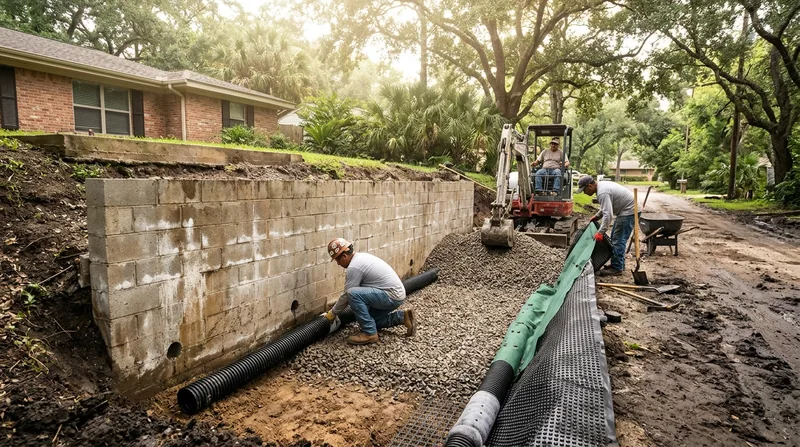




Retaining Wall Drainage in Houston is not a luxury add-on, it is the difference between a wall that lasts decades and one that fails in five years. Houston sits on the flat Gulf Coastal Plain, where expansive black gumbo clay swells when wet and shrinks when dry, a high water table persists year-round, and tropical storms and hurricane rains dump inches of water in hours. Without proper drainage, hydrostatic pressure builds behind your retaining wall, pushing it outward, cracking it, tilting it, and eventually collapsing it. Whether your wall is poured concrete, segmental block, natural stone, or timber, water management is the single most critical factor in its survival. We install French drains, weep holes, gravel backfill, and waterproofing membranes that relieve that pressure before it destroys your wall and threatens your foundation, driveway, or landscaping investment.
Why Proper Drainage Fails Most Retaining Walls in Houston
Houston homeowners often assume a retaining wall failure is a structural problem, a design flaw, or poor installation. In most cases, it is none of these. The wall fails because water accumulated behind it, exerted pressure the wall was never meant to handle, and pushed it out of plumb. Our Gulf Coast clay does not drain naturally. Rain sits in the soil, the water table rises, and any wall without an intentional drainage system becomes a dam holding back hundreds of pounds of hydrostatic force per linear foot. The result is visible tilting, horizontal cracks, separation at joints, and eventually a collapse that can damage adjacent structures and create a safety hazard.
We see this pattern in every neighborhood from the Heights to Kingwood, from Bellaire to Atascocita, from Memorial to Missouri City. The wall looked fine for a few years, then a heavy rain season or a leaking pool or landscape irrigation pushed it over the edge. Fixing it after the fact costs far more than installing drainage from the start.
- We install French drain systems that run along the wall base and carry water away to daylight or a storm drain, preventing saturation.
- We drill weep holes through the wall face at regular intervals so water trapped behind the wall has an escape route instead of building pressure.
- We backfill with gravel and filter fabric instead of clay, allowing water to percolate downward and sideways rather than pooling against the wall.
- We apply waterproofing membranes to the wall face and behind it, stopping water absorption into concrete or block and reducing saturation.
- We slope grade away from the wall and install swales or berms to redirect surface runoff before it reaches the drainage zone.
Each of these methods addresses a specific failure mode, and the best installations use all of them together, creating a redundant system that keeps your wall dry even during the heavy rain events that define Houston summers and hurricane season.
Key info: A segmental block retaining wall in Sugar Land holding back a raised planter bed failed after two years because the builder backfilled with clay and omitted weep holes. When we rebuilt it with French drainage, filter fabric, and properly spaced weep holes, the homeowner finally had a wall that stayed dry and level, even through the 2017 rain events.
For more on the structural and material side of wall failure, see our leaning and collapsed wall repair service, which addresses walls that have already failed and need emergency stabilization or replacement.
You can also verify drainage and permitting requirements with the Houston Building and Standards Commission or your local city or county building department, as setback, height, and surcharge rules vary by jurisdiction.
How We Design and Install Retaining Wall Drainage in Houston
Every drainage job starts with a site inspection. We evaluate the wall height, the soil type behind it, the grade and slope, any existing water sources (irrigation, downspouts, pool equipment, bayou proximity), the wall material, and the intended use of the space above it. A 3-foot segmental block wall around a raised planting bed needs different drainage than a 12-foot poured concrete wall holding back a steep slope. We assess whether the wall is new construction or a retrofit on an existing failing wall, and whether local permitting requires engineered drawings for the drainage system.
Once we understand the site, we design a drainage plan tailored to your wall and your soil. This plan specifies the location and depth of French drains, the spacing and diameter of weep holes, the type and thickness of backfill material, the waterproofing method, and any surface grading changes. We then execute the plan methodically, ensuring every component is installed to code and to best practices for Gulf Coast conditions.
- We excavate behind or alongside the wall to expose the wall face, remove any clay or compacted soil that blocks drainage, and prepare the surface for waterproofing and backfill.
- We apply waterproofing membrane to the wall face and the subsurface, using products rated for below-grade use and compatible with your wall material (concrete, block, stone, or timber).
- We install perforated drain pipe at the base of the wall, sloped to daylight or a storm drain, wrapped in filter fabric to prevent soil from clogging the pipe.
- We backfill with 3/4-inch drainage gravel and landscape fabric, creating a zone where water moves freely downward and toward the drain pipe rather than pressing against the wall.
- We drill weep holes through the wall face (typically 4 to 8 inches in diameter, spaced 4 to 6 feet apart) and install drain sleeves or grates so water can exit the wall without eroding soil or creating a muddy appearance.
- We restore grade, slope it away from the wall, and install surface swales or berms if needed to intercept runoff before it reaches the wall zone.
The entire process is designed to move water away from your wall as quickly as possible, whether that water comes from rainfall, groundwater, irrigation, or surface runoff. In Houston, where heavy rain is routine and the water table is high, this proactive approach is the only reliable way to keep a wall level and intact.
Real example: A concrete retaining wall in Pearland that was built 15 years ago without drainage started leaning outward and showing horizontal cracks after a wet winter. We excavated behind it, installed a French drain system with weep holes, applied a waterproofing membrane, and backfilled with gravel. The wall stabilized immediately, and five years later it remains plumb and dry, even through the heavy rains of summer 2023.
For new walls, we integrate drainage into the design from the start. For more on new construction, visit our retaining wall installation service.
Drainage Methods and Materials
| Approach | Description | Best for |
|---|---|---|
| French Drain (subsurface) | Perforated pipe buried at wall base, wrapped in filter fabric, sloped to daylight or storm drain. Collects groundwater and subsurface seepage and moves it away from the wall zone. | All walls in high water table zones (Houston norm). Essential for tall walls, tiered walls, or walls holding back slopes. |
| Weep Holes with Sleeves | Holes drilled or cast through the wall face at regular intervals, fitted with drain sleeves or grates. Allows water trapped behind the wall to exit visibly rather than building hydrostatic pressure. | Segmental block, poured concrete, and natural stone walls. Spacing and diameter depend on wall height and soil permeability. |
| Gravel Backfill with Filter Fabric | 3/4-inch diameter drainage gravel (not clay or topsoil) placed behind the wall and separated from native soil by landscape filter fabric. Allows rapid water percolation and prevents clay from clogging drainage paths. | Every new wall and every drainage retrofit. Mandatory in Houston's clay-heavy soils where native backfill will not drain. |
| Waterproofing Membrane | Liquid or sheet-applied membrane (asphalt-based, rubberized, or synthetic) applied to the wall face and subsurface. Stops water absorption into the wall and reduces saturation of backfill material. | Concrete and segmental block walls where water infiltration and freeze-thaw damage are concerns. Highly recommended in Houston for long-term durability. |
| Surface Grading and Swales | Sloping grade away from the wall (minimum 5 percent slope for 6 feet) and installing shallow swales or berms to intercept surface runoff and direct it away from the wall zone. | All installations. Reduces the volume of water that reaches subsurface drainage systems and prevents pooling on the wall face during heavy rain. |
The most resilient drainage systems in Houston combine two or more of these methods. A typical retrofit includes French drain, weep holes, gravel backfill, and surface grading. A new tall wall or engineered wall may add a waterproofing membrane and additional subsurface components. We tailor the scope to your wall, budget, and site conditions.
Retaining Wall Drainage Cost in Houston: What to Expect
Retaining wall drainage costs in Houston typically start at $2,500 for a straightforward retrofit on a short wall (6 to 8 feet long, 3 to 4 feet tall) with basic French drain and weep hole work. Larger projects, taller walls, or walls requiring full excavation and waterproofing can reach $8,000 to $15,000 or more. The final price depends on wall length, height, material, accessibility, soil conditions, whether the wall is existing or new, and the complexity of the drainage design.
A few factors move the cost up or down. A wall that is easy to access and has already been partially exposed costs less to retrofit than one buried under landscaping or sitting in a tight corner. A wall in stable, well-draining soil costs less than one in deep clay or next to a bayou where the water table is high and the drainage system must be more robust. A short segmental block wall costs less than a 12-foot poured concrete wall or a tiered system. Material choice also matters: a waterproofing membrane adds $1,000 to $3,000 depending on wall size, but it extends wall life significantly in Houston's humid, wet climate.
We recommend getting two or three estimates from licensed contractors so you can compare scope, materials, and price. A low estimate that omits French drain or weep holes is not a bargain, it is a setup for failure. A high estimate that specifies every component and explains why each one is necessary is the one to trust. For a full pricing overview and to see how drainage costs fit into your overall retaining wall project, visit our pricing page.
Call us at (346) 258-3418 for a free, no-obligation estimate. We will walk your site, explain what your wall needs, and give you a realistic price before you commit to anything.
What to Look for When Hiring a Retaining Wall Drainage Contractor Near Me in Houston
Not all contractors understand retaining wall drainage. Many general landscapers and handymen can dig a hole and backfill it, but they may not know how to design a French drain system, space weep holes correctly, or select the right filter fabric and gravel for Houston's clay soils. When you are hiring a drainage specialist, look for contractors who have done this work repeatedly, can explain their design reasoning, and carry the right insurance and licenses for your area.
Start by verifying that the contractor is licensed and insured for retaining wall work in your city or county. Texas requires a contractor license for certain work, and many Houston-area cities require a local business license and proof of liability and workers compensation insurance. Ask for a copy of their insurance certificate and verify it is current. A contractor without insurance is a liability you do not want to assume.
Ask for three references from drainage or retaining wall projects completed in the past two years, ideally in your neighborhood or a similar soil type. Call them, ask how the wall has performed, whether any drainage issues have come up, and whether the contractor stood behind the work. A contractor with solid references is one you can trust to do the job right.
Understand permitting requirements for your wall. In Houston, many jurisdictions require a permit for retaining walls above roughly 4 feet, or when a wall supports a surcharge (driveway, structure, or slope). Some require engineered drawings. Ask your contractor whether a permit is needed, who obtains it, and how long it takes. A contractor who avoids this conversation is cutting corners. Always verify with your local building department, as thresholds and rules vary by city and county.
Check whether your HOA or neighborhood has restrictions on wall height, materials, or setback from property lines. Some communities require architectural approval before any retaining wall work. Your contractor should ask about this during the estimate and help you navigate the approval process if needed.
Finally, get the drainage plan in writing. A professional estimate should include a sketch or site plan showing where the French drain will run, where weep holes will be located, what backfill material will be used, and any waterproofing or surface grading work. If the estimate is vague or just a number with no details, ask for clarification. A detailed estimate is a sign of a professional who has thought through the job and knows what it takes to make it last.
Ready to protect your wall with proper drainage? Contact us today for a free estimate and a consultation with a drainage specialist who knows Houston.
Retaining Wall Drainage in Houston: Pricing Guide
| Service | Price | Details |
|---|---|---|
| French Drain System (subsurface only) | Starting at $2,500 | Perforated pipe, filter fabric, and gravel backfill along wall base; includes labor and materials for standard-access, short to mid-length walls |
| Weep Hole Installation with Sleeves | Starting at $1,200 | Drilling, sleeves, and grates for typical segmental block or concrete wall; price scales with wall length and material hardness |
| Full Drainage Retrofit (French drain, weep holes, waterproofing, grading) | Starting at $5,500 | Comprehensive system for existing failing or at-risk walls; includes excavation, membrane, backfill, and surface slope correction |
| Drainage for New Wall Installation | Starting at $3,000 | Integrated into new construction; includes base prep, French drain, weep holes, filter fabric, and gravel backfill as part of wall build |
| Large or Complex Drainage Project | On estimate | Tall walls, tiered systems, bayou-adjacent sites, or engineered designs require site visit and detailed assessment before pricing |
| Free Estimate and Site Consultation | Free | No obligation; we visit your site, evaluate drainage needs, explain options, and provide a detailed written quote within 24 hours |
Indicative pricing, the exact cost depends on square footage, finish, and site access. Free personalized estimate within 24h at (346) 258-3418.


