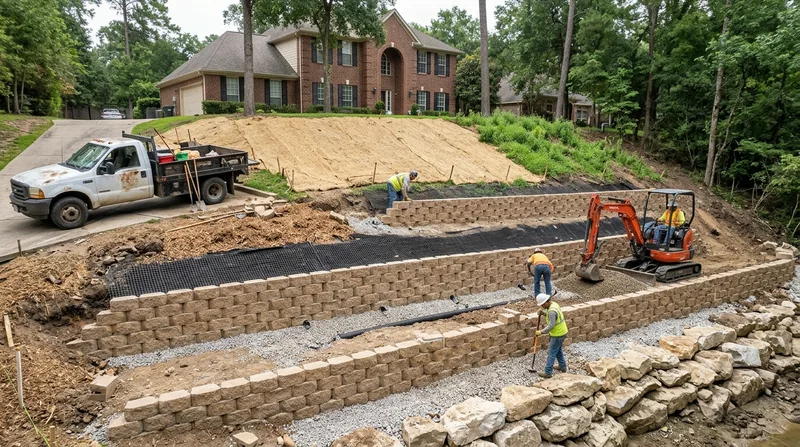




Slope stabilization and erosion control in Houston protects your home, driveway, and yard from the relentless forces that threaten properties on bayou banks, ravine lots, and cut-and-fill pads across the region. Houston sits on the flat Gulf Coastal Plain, sliced by Buffalo, Brays, White Oak, and Greens bayous with their steep, eroding banks and wooded ravines. When heavy rains hit, expansive black gumbo clay swells and shrinks, the water table rises, and ground subsidence accelerates erosion. A single tropical storm or hurricane can wash away years of stability. Houston Retaining Wall stabilizes failing slopes with terraced retaining walls, geogrid reinforcement, and drainage systems that work with the local soil and climate to stop erosion before it compromises your foundation or landscape. Call (346) 258-3418 for a free estimate, or learn more about our retaining wall installation services.
Why Slope Stabilization Matters on Houston's Bayou Banks and Ravine Lots
Houston's topography is deceptive. While the city appears flat, the bayous and ravines cut deep channels through neighborhoods from the Heights to Bellaire, from Memorial to Kingwood. Homes built on these banks or on cut-and-fill pads face constant pressure from water infiltration, soil creep, and subsidence. The black gumbo clay that dominates the region swells when wet and shrinks when dry, creating cycles of stress that crack and heave retaining walls. Combined with Houston's intense hurricane and tropical storm rainfall, slope failure is not a question of if but when, without proper stabilization.
- Expansive clay soil swells after heavy rain and destabilizes unbraced slopes, pushing walls outward and cracking foundations.
- High groundwater tables near bayous and ravines saturate soil and reduce friction, allowing earth to creep downhill.
- Ground subsidence in areas like Meyerland and Oak Forest compounds slope stress and opens gaps between soil and walls.
- Torrential hurricane and tropical storm runoff overwhelms uncontrolled drainage, eroding banks and undermining wall footings.
- Tiered landscaping and raised decks add surcharge weight to slopes, accelerating failure if not reinforced with geogrid and proper drainage.
Stabilizing a slope before it fails saves thousands in foundation repair, landscape replacement, and emergency remediation. For more on how we repair walls that have already shifted, see our leaning and collapsed wall repair page.
Key info: Homes in Sugar Land, Pearland, and League City built on the edges of ravines and detention ponds face accelerated erosion after each storm season. A single year of uncontrolled runoff can trigger slope failure that costs $15,000 to $40,000 to repair. Stabilization now prevents crisis later.
For specific permit requirements and slope angle rules in your jurisdiction, always check with your local building department. Most Houston-area municipalities require a permit for walls taller than 4 feet or walls that support a surcharge such as a driveway or structure. See your city's building and development services page for details.
How We Stabilize Slopes: Our Step-by-Step Approach in Houston
Slope stabilization is not a one-size-fits-all job. Houston's mix of soil types, water tables, and existing wall conditions demands a site-specific strategy. We begin with a free on-site assessment to identify the failure mode, measure slope angle and height, evaluate drainage, and test soil composition. From there, we design a terraced wall system, specify geogrid reinforcement layers, and install perimeter and subsurface drainage to control water flow. The result is a stable, durable slope that sheds water and resists the swelling pressure of Houston's clay.
- We inspect the slope, measure height and angle, and identify signs of active erosion, seepage, or soil creep.
- We design a terraced retaining wall layout with proper setback from property lines and compliance with local building codes.
- We install geogrid reinforcement layers within the retained soil to increase tensile strength and prevent internal failure.
- We set drainage pipes and gravel at the wall base and behind the retained soil to intercept groundwater and direct it away from the slope.
- We grade the slope surface to shed surface runoff and install erosion control matting or vegetation to stabilize the top soil layer.
- We backfill with compacted, well-draining soil and monitor settlement over the first few weeks to ensure proper consolidation.
This phased approach takes 1 to 3 weeks depending on wall height, slope length, and access. The investment pays dividends in decades of stable, erosion-free property. Learn more about our retaining wall drainage solutions to see how water management is the backbone of every slope stabilization job.
Local example: A 1970s brick home in Kingwood backed onto a ravine with a 12-foot slope showing active erosion and a leaning timber wall. We terraced the slope with two tiers of segmental block walls, installed geogrid and perforated drainage behind each tier, and graded the top with native plantings. The slope is now stable, water is diverted safely, and the property value is protected.
Slope Stabilization Methods: Choosing the Right System for Your Soil and Site
| Approach | Description | Best for |
|---|---|---|
| Segmental Block with Geogrid | Modular concrete blocks stacked in tiers with geogrid strips layered between each course to reinforce the retained soil mass. | Slopes 6 to 15 feet high with moderate to high clay content; allows staged construction and easy access for drainage. |
| Poured Concrete with Subsurface Drain | Monolithic concrete wall cast in place with perforated drain pipe and gravel backfill to manage groundwater pressure. | High water table sites near bayous; slopes with severe subsidence; applications requiring maximum strength and durability. |
| Boulder and Rock Terracing | Large boulders and limestone blocks set with geotextile and drainage to create a natural-looking, permeable terrace. | Slopes in wooded ravines or upscale neighborhoods where aesthetics matter; moderate slopes with good drainage potential. |
| Soil Nailing with Erosion Control Matting | Steel nails driven horizontally into the slope face to anchor soil, paired with biodegradable matting and vegetation to control surface runoff. | Slopes too steep or too constrained for a traditional wall; sites where minimal footprint is required; temporary or transitional stabilization. |
| Terraced Walls with Perimeter Swale | Multiple lower walls stepping down the slope, with a graded swale at the top to intercept and channel runoff away from the slope face. | Long or very steep slopes; sites draining toward the property; landscapes where surface water management is the primary concern. |
Each method is engineered for Houston's soil profile, water table depth, and rainfall intensity. We select the approach based on your slope geometry, soil composition, budget, and aesthetic goals. Call (346) 258-3418 to discuss which method fits your site.
Slope Stabilization and Erosion Control Cost in Houston: What to Expect
The cost of slope stabilization and erosion control in Houston depends on wall height, slope length, soil conditions, access, and the method you choose. A simple terraced block wall on a 6-foot slope might run $3,500 to $7,500, while a 15-foot poured concrete wall with subsurface drainage on a high water table site can reach $12,000 to $25,000 or more. The single biggest factor is wall height and the geotechnical complexity of your site. Slopes with known subsidence, high groundwater, or poor soil stability require more robust reinforcement and drainage, which increases cost. Access difficulty, proximity to structures, and the need for temporary shoring also push estimates higher.
We recommend getting a free on-site estimate before committing to a budget. Our inspection identifies the actual failure mode, soil type, and drainage challenges specific to your property. From there, we provide a detailed scope and price. Many homeowners are surprised to learn that investing in proper stabilization now costs far less than emergency foundation repair or landscape replacement after a slope failure. Visit our pricing page for more detail on cost factors and typical project ranges.
Factors that move the price up include: slopes steeper than 45 degrees, walls taller than 12 feet, high groundwater or active seepage, proximity to existing structures or utilities, poor soil bearing capacity, and need for engineered drawings or a licensed engineer stamp (often required for walls over 8 feet or in HOA-controlled properties). If your slope has failed before or is actively eroding, remediation costs increase because we must address the underlying damage in addition to stabilization.
Slope Stabilization and Erosion Control Near Me: What Houston Homeowners Should Know When Hiring a Contractor
Choosing the right contractor for slope stabilization is critical. A poorly designed or installed wall will fail within a few years, costing you far more in the long run. Start by verifying that any contractor you consider is licensed and insured for retaining wall and grading work in Texas. Ask for proof of liability coverage and workers compensation. Check references from recent slope stabilization jobs in your neighborhood, Bellaire, Missouri City, or other Houston-area communities. Request at least two other estimates so you can compare scope, materials, and price. Ask each contractor whether they handle permitting or if you need to pull the permit yourself; this varies by city and project size.
Understand your HOA rules before hiring. Some neighborhoods in The Woodlands, Sugar Land, and Pearland restrict wall materials, height, or setback distance from property lines. Confirm that your contractor knows these rules and can work within them. Ask about warranty: most reputable contractors offer a 2 to 5 year warranty on workmanship and materials. Finally, verify that the contractor understands Houston's soil and climate. Slope stabilization here is not the same as in Colorado or California; our black gumbo clay, high water table, and hurricane-intensity rain demand specific design and drainage expertise. Contact us at (346) 258-3418 or visit our contact page to request a free estimate and discuss your slope stabilization needs with a field professional who knows Houston terrain inside and out.
Slope Stabilization & Erosion Control in Houston: Pricing Guide
| Service | Price | Details |
|---|---|---|
| Free On-Site Estimate | Free | We inspect slope height, angle, soil type, drainage, and failure mode to provide accurate pricing and design recommendation |
| Terraced Block Wall Stabilization | Starting at $3,500 | Single or double-tier segmental block walls with geogrid and drainage for slopes 6 to 12 feet high with moderate clay soil |
| Poured Concrete Slope Wall | Starting at $7,500 | Monolithic concrete wall with subsurface perforated drain for high water table sites, severe subsidence, or slopes over 12 feet |
| Boulder and Rock Terracing | Starting at $4,500 | Natural stone or large boulders set with geotextile and drainage for aesthetic terracing on wooded ravine or premium neighborhood slopes |
| Full Slope Remediation | On estimate | Complex multi-tier walls, soil nailing, regrading, drainage swales, and erosion matting for severely failed or high-risk slopes require site assessment |
| Travel and Mobilization | Included | No separate travel fee within Houston service area; equipment and crew mobilization are part of the project estimate |
Indicative pricing, the exact cost depends on square footage, finish, and site access. Free personalized estimate within 24h at (346) 258-3418.


