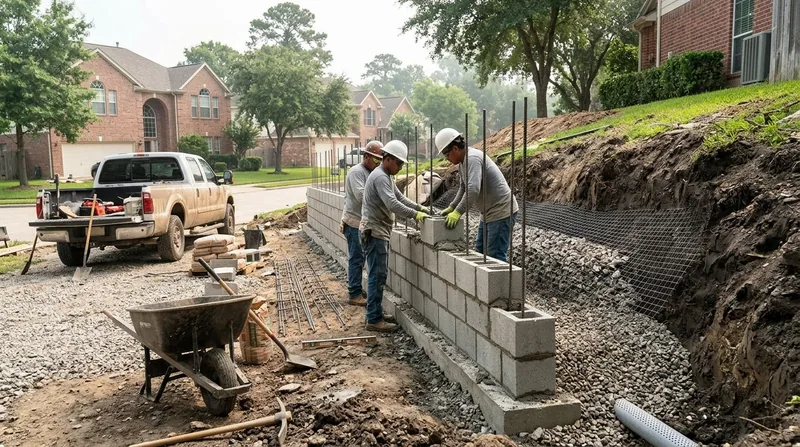




Concrete retaining walls in Houston are the workhorse solution for stabilizing eroding bayou banks, supporting driveways on uneven ground, and holding back the black gumbo clay that swells and shrinks with every rain and dry spell. Houston's flat Gulf Coastal Plain is cut by Buffalo, Brays, White Oak, and Greens bayous with their steep, wooded ravines, and homes throughout the Heights, River Oaks, Meyerland, and the master-planned suburbs all face the same challenge: managing water, clay movement, and ground subsidence. Poured concrete and reinforced CMU block walls with engineered footings and weep holes are the strongest, longest-lasting choice for the wet, humid climate and heavy tropical storms that dominate this region. We build concrete retaining walls that hold fast against Houston's most aggressive soil and weather conditions, and we repair or replace the walls that have already failed. Call us at (346) 258-3418 for a free, no-obligation estimate, or learn more about our full retaining wall installation services.
Why Concrete Retaining Walls Matter in Houston's Challenging Soil and Climate
Houston's soils are dominated by expansive black gumbo clay that swells dramatically when wet and shrinks when dry, creating enormous lateral pressure on any wall that tries to hold it back. A high water table, ground subsidence, and the torrential rain from hurricanes and tropical storms mean that wood, stone, and poorly built walls fail fast. Concrete and reinforced CMU block walls with proper engineering, deep footings, rebar, and drainage systems are built to survive decades of this punishment without tilting, cracking, or collapsing.
- Concrete walls resist the constant push of swelling clay and hydrostatic pressure from saturated soil.
- Engineered footings extend below the frost line and active clay zone, preventing settlement and heave.
- Weep holes and drainage systems behind the wall prevent water buildup that weakens the structure and accelerates failure.
- Reinforced rebar and proper concrete mix design give the wall tensile strength to crack-resist and hold its shape under load.
- Tall walls, tiered systems, and walls supporting driveways or structures require professional engineering and permitting to meet Houston building codes.
A well-built concrete retaining wall is an investment that protects your foundation, landscape, and property value for 30, 40, or 50 years.
Key info: Many Houston jurisdictions require a permit for walls taller than roughly 4 feet measured from the footing, or when a wall supports a surcharge such as a driveway or structure. Engineered drawings may be required for tall or tiered walls. Setback and property-line rules apply. Always verify thresholds with your local building department, as requirements vary by city. For details, consult the City of Houston Development Services or your municipality's building and permitting office.
For more on what fails and how to fix it, see our guide to leaning and collapsed wall repair.
How We Build Concrete Retaining Walls in Houston: Process and Precision
Every concrete retaining wall we build starts with a site assessment and soil evaluation. We dig test pits to understand the clay, water table, and bearing capacity, then design a footing deep enough to avoid frost heave and clay movement. We set up proper drainage, pour or build the wall with reinforced concrete or CMU block, and finish with a clean surface that sheds water and complements your landscape.
- We visit your property, assess soil conditions, and measure the slope and grade to determine wall height and footing depth.
- We obtain or confirm that permits are in place, and we review any engineered plans required by your local building department.
- We excavate the footing trench below the active clay zone and below frost depth, and we compact the subgrade.
- We set up forms or lay CMU block, install rebar per design, and pour reinforced concrete with the right mix for Houston's wet climate.
- We install weep holes or a drainage system behind the wall to prevent water and hydrostatic pressure from building up.
- We backfill with compacted, free-draining soil and finish the top and face for durability and appearance.
From a small raised planter in Bellaire to a tall bayou-bank wall in the Heights or a driveway support in Kingwood, we follow the same engineering rigor and attention to detail.
Local example: A homeowner in Missouri City had a 6-foot timber wall holding back black gumbo clay on a steep slope. After five years of wet seasons and subsidence, the wall tilted and cracked. We removed the old wall, dug a new footing 3.5 feet deep below the active clay zone, poured a reinforced concrete wall with a 2-foot base, installed a perforated drain behind it, and backfilled with compacted sand and gravel. The new wall has held solid for over three years and will last another 40.
For more on how drainage protects your wall, visit our retaining wall drainage service page.
Concrete Retaining Wall Methods: Poured Concrete vs. CMU Block
| Approach | Description | Best for |
|---|---|---|
| Poured Concrete | Monolithic wall cast in place with reinforced rebar, full-height pour, custom thickness and shape, integral weep holes and drainage. | Tall walls (8+ feet), high-load applications, tight spaces, maximum durability and minimal maintenance. |
| CMU Block (Reinforced) | Concrete masonry units stacked and mortared, with vertical and horizontal rebar, grouted cores, and face finish options (split face, smooth, painted). | Walls 4 to 8 feet, moderate-load slopes, visible finish quality, faster construction than poured concrete. |
| Tiered Poured Concrete | Multiple stepped walls, each with its own footing and drainage, used to manage tall slopes or to create terraced landscape levels. | Slopes taller than 10 feet, properties in Conroe or The Woodlands with significant grade changes, multiple planting levels. |
| Engineered Hybrid | Combination of poured concrete base with CMU block face, or reinforced concrete core with stone or brick veneer for aesthetic and structural optimization. | High-visibility areas, historic neighborhoods (Heights, River Oaks), walls where appearance and strength must both be premium. |
Concrete Retaining Walls Cost in Houston: What to Expect
Concrete retaining walls in Houston start at $35 per square foot for straightforward, properly engineered poured concrete or reinforced CMU block walls on stable ground with good access. A 30-foot-long, 4-foot-tall wall runs roughly 120 square feet and costs between $4,200 and $5,400. Taller walls, complex slopes, poor soil conditions, tight access, or engineered tiered systems push the cost higher, often $50 to $75 per square foot or more.
The biggest cost drivers are wall height, footing depth (determined by soil and clay movement), site access, and whether the wall must support a surcharge like a driveway or structure. A wall in Pearland on a gentle slope with good drainage may cost less than a tall bayou-bank wall in the Heights with black gumbo clay, high water table, and tight access between existing homes. We recommend getting two or three estimates from licensed, insured contractors so you can compare scope, materials, and timeline. Visit our full pricing overview for more detail, or call (346) 258-3418 to schedule a free on-site estimate.
Permit costs, engineering fees, and drainage or site preparation add to the total, but they are essential investments in a wall that will not fail, settle, or cost you thousands in foundation repair down the road.
Concrete Retaining Walls Near Me: What to Look for When Hiring a Contractor in Houston
A concrete retaining wall is only as good as the contractor who builds it. Ask for references from recent projects in your area, whether Sugar Land, Tomball, League City, or Humble, and call at least two of them. Understand permit requirements for your property and municipality, and confirm that your contractor will handle or coordinate all permitting and inspections with the local building department.
Check whether your HOA has restrictions on wall height, materials, or setback from property lines, and ensure your contractor factors those into the design. A contractor who rushes through site assessment, skips soil testing, or offers a price that seems too low is cutting corners on footing depth, rebar, or drainage, and your wall will fail within a few years. Get everything in writing, including the scope, timeline, warranty, and what happens if the wall settles or cracks. Licensed contractors stand behind their work and are insured if something goes wrong.
Ready to move forward? Contact us for a free estimate, or call (346) 258-3418 to discuss your project. We serve Houston, Sugar Land, Pearland, League City, Baytown, Missouri City, Conroe, The Woodlands, Friendswood, Katy, Spring, Humble, Tomball, Bellaire, Atascocita, and Rosenberg.
Concrete Retaining Walls in Houston: Pricing Guide
| Service | Price | Details |
|---|---|---|
| Poured Concrete Wall | Starting at $35/sq ft | Monolithic reinforced concrete, engineered footing, weep holes and drainage included; cost rises with wall height, footing depth, and soil complexity |
| Reinforced CMU Block Wall | Starting at $32/sq ft | Stacked concrete block with rebar and grout, finished face; faster than poured concrete but requires more labor; material and finish options affect final price |
| Tiered or Complex Wall System | On estimate | Multiple walls, tall slopes, or hybrid designs require site assessment, soil testing, and engineered drawings before pricing; typically $50 to $75 per square foot |
| Repair or Replacement of Failed Wall | On estimate | Removal, new footing, and rebuild; cost depends on existing wall size, debris, soil conditions, and whether the old structure can be salvaged or must be demolished |
| Travel and Estimate | Free and included | No mileage fee or travel charge within Houston and surrounding service areas; free on-site estimate within 24 hours at (346) 258-3418 |
Indicative pricing, the exact cost depends on square footage, finish, and site access. Free personalized estimate within 24h at (346) 258-3418.


