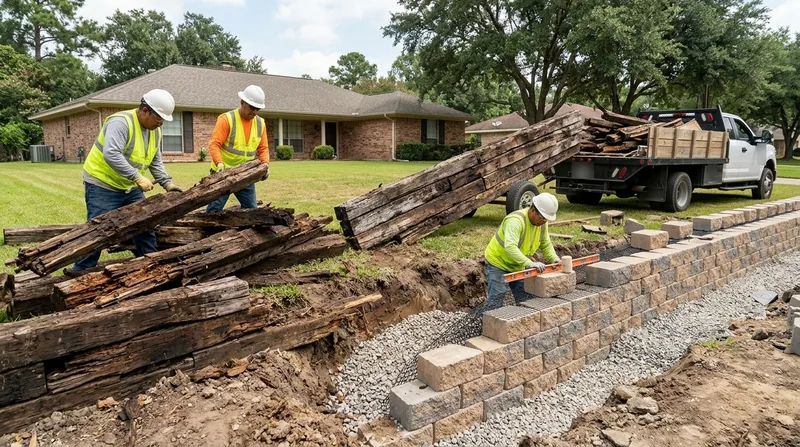




Railroad Tie Wall Replacement in Houston is a critical service for homeowners with aging landscape borders built in the 1970s, 1980s, and 1990s. These creosote-treated timber structures fail predictably in our Gulf Coast climate: the black gumbo clay beneath them swells and shrinks with seasonal moisture, the high water table weakens the wood from below, and torrential hurricane and tropical storm rain accelerates decay and undermines the wall's footing. In neighborhoods from the Heights to Meyerland, from Sugar Land to The Woodlands, old railroad tie walls tilt, buckle, and collapse under the weight of saturated soil and the relentless pressure of our expansive clay. We remove these failing walls completely, haul away the creosote-contaminated ties, rebuild proper drainage and gravel backfill, and install a new wall in segmental block, poured concrete, or natural stone that will stand for decades.
Why Railroad Tie Wall Replacement Matters in Houston's Climate
Houston's flat terrain and shallow water table make old timber walls vulnerable in ways that homeowners often don't see until failure is imminent. The Gulf Coastal Plain soils expand and contract with rainfall, the bayous and their tributaries, Buffalo, Brays, White Oak, and Greens, cut steep, eroding banks through wooded ravines, and our hazy, humid summer heat and sudden tropical deluges create ideal conditions for wood rot and structural movement. A railroad tie wall that looked solid ten years ago may now be leaning, cracked, or actively collapsing, threatening landscaping, drainage, and property value.
- We identify creosote saturation, wood rot, and structural tilt before they cause catastrophic failure and costly emergency repairs.
- We remove the entire failed wall, haul away treated timber responsibly, and dispose of it according to Houston-area environmental guidelines.
- We install new drainage and gravel backfill to prevent the water table and clay movement from undermining your replacement wall.
- We rebuild with segmental block, concrete, or stone, materials that thrive in our wet, expansive soil and extreme weather.
Taking action now prevents a slow tilt from becoming a sudden collapse that damages adjacent structures, driveways, or utilities.
Key info: Many Houston jurisdictions require a permit for walls above roughly 4 feet measured from the footing, or when a wall supports a surcharge such as a driveway. Verify setback and property-line rules with your local building department before removal begins. For details on what permits apply to your wall, visit the Houston Public Works website or contact your city or county code office.
How We Replace Railroad Tie Walls: Step-by-Step Process
Our replacement process begins with a thorough site inspection to assess the wall's condition, measure its dimensions, check drainage and soil stability, and identify any hidden utilities or property-line issues. We then plan the demolition, design the new wall to match your landscape and budget, and coordinate any required permits with the local building department. Once we begin work, we move systematically from removal through drainage installation to the final wall build, leaving your property clean and your new wall ready for landscaping.
- We excavate around the failing wall and carefully remove all creosote-treated railroad ties, stacking them for responsible disposal.
- We clear the site of debris, old nails, and contaminated soil, and haul away all material off-property.
- We excavate to the proper footing depth and prepare the base with compacted gravel and drainage fabric to handle Houston's high water table.
- We build the new wall in your chosen material (segmental block, poured concrete, or natural stone) to the designed height and alignment.
- We install backfill gravel and perforated drainage pipe behind the new wall to shed water and prevent future pressure buildup.
- We finish the top of the wall and grade the surrounding area to slope away from the structure.
The entire process typically takes 5 to 10 business days depending on wall size, material choice, and site access.
Local example: A homeowner in River Oaks with a 25-foot-long railroad tie wall leaning into her brick Tudor's foundation had us remove the old ties, dig down to proper footing, and rebuild in stacked natural stone with full drainage. The new wall matches the neighborhood's historic character, handles our clay and water table, and will serve for 50 years or more. See our retaining wall replacement service for more examples of failed walls we've rebuilt.
Material Options for Your New Wall
Once the old railroad ties are gone, you have three proven options for your replacement wall. Each material performs differently in Houston's climate, and your choice depends on your budget, aesthetic preference, and the wall's height and load.
| Material | Description | Best for |
|---|---|---|
| Segmental Block (SRW) | Modular concrete units stacked and pinned; allows slight settling without cracking; excellent drainage capability. | Most Houston applications; pool surrounds; raised beds; 4 to 12 feet tall; budget-conscious homeowners. |
| Poured Concrete | Monolithic wall cast on-site; maximum strength; minimal maintenance; can be textured or colored to match surroundings. | Tall walls (8 feet plus); heavy surcharge (driveway, structure); maximum longevity and resale value. |
| Natural Stone (Stacked or Faced) | Limestone, granite, or fieldstone; aesthetic warmth; excellent durability in our humid climate; higher labor cost. | Historic neighborhoods; high-end properties; walls visible from street; homeowners prioritizing curb appeal. |
| Hybrid (Block with Stone Facing) | Segmental block core with natural stone or limestone veneer; combines strength and aesthetics; moderate cost. | Mid-range budgets; visible walls in suburban settings; 4 to 8 feet tall; balanced performance and appearance. |
All materials work well in Houston when properly installed with drainage and gravel backfill. We help you choose based on your site, budget, and long-term goals.
Railroad Tie Wall Replacement Cost in Houston: What to Expect
Railroad tie wall replacement in Houston typically starts at $35 per square foot for basic segmental block work on a straightforward site. That price covers demolition and haul-away of the old ties, proper footing and gravel backfill, drainage installation, and the new wall itself. The final cost depends on several real-world factors: the wall's length and height, accessibility for equipment, soil conditions and water table depth, whether the wall supports a surcharge (driveway, structure, or landscaping load), and your choice of material.
A 30-foot-long, 4-foot-tall segmental block wall in a standard backyard typically runs $4,200 to $5,400. A taller wall, one in natural stone, or one that requires engineered design and special drainage can easily reach $8,000 to $15,000 or more. We always provide a free, no-obligation estimate within 24 hours of your call to (346) 258-3418. Getting 2 or 3 estimates is smart: it helps you compare scope, material, and timeline, and ensures you're not overpaying for a straightforward job or underestimating a complex one.
See our full pricing overview for detailed breakdowns by material and complexity, and call us to discuss your wall's specific needs.
Railroad Tie Wall Replacement Near Me: What Houston Homeowners Should Know When Hiring
Choosing the right contractor for railroad tie wall replacement is as important as choosing the material. A poorly executed removal leaves contaminated soil behind; bad drainage leads to failure in 5 years; and cutting corners on footing depth or backfill invites collapse under our heavy clay and water pressure. Before you hire, verify that your contractor is licensed and insured, ask for references from recent jobs in Houston, understand what permits your local building department requires, and get a detailed written estimate that spells out what's included and what isn't.
- We obtain all required permits before work begins and coordinate with your local building department to ensure compliance with setback and height rules.
- We provide references from recent jobs in your neighborhood and welcome you to call past clients to ask about our work quality and professionalism.
- We give you a written estimate that includes demolition, disposal, footing prep, drainage, the new wall, and final grading so there are no surprises.
- We discuss HOA requirements or deed restrictions that may affect wall height, material, or design before we finalize the plan.
Houston Retaining Wall has built a reputation for honest pricing, clean work, and walls that last. Contact us for a free estimate and let us show you why homeowners across Houston trust us with their failed walls and their property's long-term stability.
Railroad Tie Wall Replacement in Houston: Pricing Guide
| Service | Price | Details |
|---|---|---|
| Segmental block wall replacement | Starting at $35/sq ft | Includes demolition, haul-away, footing prep, gravel backfill, drainage, and new block wall installation |
| Poured concrete wall replacement | Starting at $45/sq ft | Higher cost reflects concrete placement, finishing, and superior strength in tall walls or under heavy surcharge |
| Natural stone or hybrid wall replacement | Starting at $50/sq ft | Premium material and labor for aesthetic appeal; ideal for visible walls in historic or high-end neighborhoods |
| Complex or engineered wall | On estimate | Tall walls, steep slopes, poor soil, or high water table require site inspection and engineered design before pricing |
| Permit and site prep | Included | We handle all local building department coordination and footing excavation as part of the replacement cost |
| Free estimate | No charge | Response within 24 hours at (346) 258-3418; includes site walk, material options, and written proposal |
Indicative pricing, the exact cost depends on square footage, finish, and site access. Free personalized estimate within 24h at (346) 258-3418.


